
Subscribe now and receive weekly newsletters with educational materials, new courses, interesting posts, popular books, and much more!
Articles

D-Day +80: How the Allies Won at Normandy and Changed History
No Comments

Invasion area showing channels cleared of mines, vessels engaged in bombardment and targets on shore. (HMSO, Crown Copyright expired)
Of all the remembrances of D-Day eighty years on, we find this the most compelling. It is extracted from Andrew Roberts’ article by the same title published in National Review, 16 May 2024 by kind permission of the author and publishers. We have added pertinent links to people and topics. For the original text click here.
0000 Hours, Tuesday, 6 June 1944
British and American airborne troops, flown in on more than 1000 aircraft, began to land in occupied Normandy to secure key objectives before the landings by sea. Elite Pathfinder units arrived first, marking out the terrain. “The first Skytrains appeared,” one observer later recalled, “silhouetted like groups of scudding bats.”
German flak hit the planes “like large hailstones on a tin roof.” Paratroopers trod floors slippery with vomit before jumping—down and down, thousands of feet, sometimes through cloud and fog. They were weighed down by up to eighty pounds of weapons, ammunition and supplies. They knew that when they reached the ground, there would be merciless opposition. Some of those whose parachutes got caught in trees were burned alive by flamethrowers. They fought in fields and hedgerows lit only by the moon or by tracer fire.
What men they were. How can we not, reading of their actions that extraordinary day, hold our manhoods cheap when we contemplate what they attempted and achieved?
It makes us wonder how we would have fared had it been our generation that had to liberate Europe from Nazism. “Every man thinks meanly of himself for not having been a soldier,” said Dr. Johnson, “or not having been at sea.”
Let us contemplate the experiences of the men who fought on D-Day eighty years ago June 6th. Let us appreciate the true nature of what we, sometimes all too glibly, call the “Greatest Generation.”
0215 Hours
Part of the vast invasion fleet of more than 6800 vessels was spotted by the Germans in Cherbourg. But the Wehrmacht was already fighting Allied airborne troops and could not comprehend the totality of the largest seaborne assault in history.
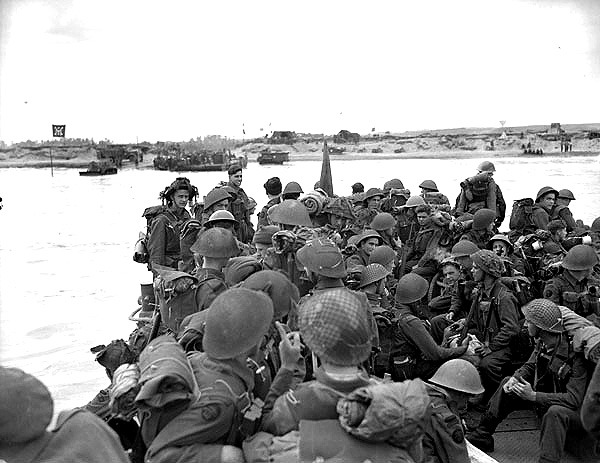
One German noncommissioned officer said the ships looked like “a gigantic town on the sea.” The defenses at Cherbourg were so powerful that the Allied planners had to choose five beaches on which to land, in what was to be the greatest campaign of the western war.
Unlike the strategy of any other military operation in the twentieth century, this one depended for success on a single day’s fighting. If what the planners described as a “satisfactory foothold” had not been gained by nightfall, it very likely wouldn’t be gained at all. It was therefore a desperate, war-defining risk. It justified the commitment of no fewer than ten army divisions, going ashore in two great waves.
Prime Minister Winston Churchill fully recognized the dangers. In the fifth volume of his memoir, The Second World War, he wrote about the demands for an early “second front” in western Europe:
The Channel tides have a play of more than twenty feet, with corresponding scours along the beaches. The weather is always uncertain, and winds and gales may whip up in a few hours irresistible forces against frail human structures. The fools or knaves who had chalked “Second Front Now” on our walls for the past two years had not had their minds burdened by such problems. I had long pondered upon them.
“War but not folly”
An overhasty return to the Continent could have resulted in disaster. As Churchill told Joseph Stalin, who was demanding an immediate second front in August 1942: “War was war but not folly, and it would be folly to invite a disaster which would help nobody.”
There had already been a long history of failed or faulty amphibious operations in both world wars—Gallipoli, Dakar, Dieppe, Salerno, Anzio. Landing troops on hostile shores against determined enemy resistance is the hardest of all military maneuvers.
Field Marshal Gerd von Rundstedt, the German commander in chief in the west, believed that the Allies would require four consecutive days of good weather to conduct a successful cross-Channel operation. None of his forecasters could see such a clear period. Fortunately, he had no access to an RAF meteorology report indicating that despite a storm on June 5th, the weather would improve long enough for the invasion to take place the next day.
Supreme Commander of the Allied Expeditionary Force General Dwight D. Eisenhower, who was smoking eighty Camel cigarettes a day and had hypertension, took the momentous decision to launch the invasion. He watched with tears in his eyes as the 101st Airborne Division took off from Greenham Common that night.
The stakes could hardly have been higher. Had D-Day failed, it would have postponed the liberation of western Europe by at least a year. With the Germans developing new weaponry, such as rockets with one-ton warheads, refuelable U-boats, jet aircraft, and advanced underwater mines, the war could have dragged on far longer. If meanwhile the Russians destroyed the German armies, nothing could have prevented most of western Europe from falling under Stalin’s Communist grip.
Supreme expression
D-Day was the result of two years’ diligent planning between American, British and Canadian staffs. When Lieutenant General Sir Frederick Morgan arrived at the planning headquarters at Norfolk House in St. James’s Square to start it, all he found in his new office was a pencil that someone had dropped on the floor. “Well, there it is,” General Sir Alan Brooke said of the operation. “It won’t work, but you must bloody well make it.”
The highly talented Anglo-American-Canadian staff did make it work. Ultimately Operation Overlord was to be the supreme expression of the cooperation, strength, and determination of the English-Speaking Peoples. The debacle at Dieppe in August 1942—in which 3900 mainly Canadian invaders had been killed, wounded, or captured—stood before the planners as a terrible warning.
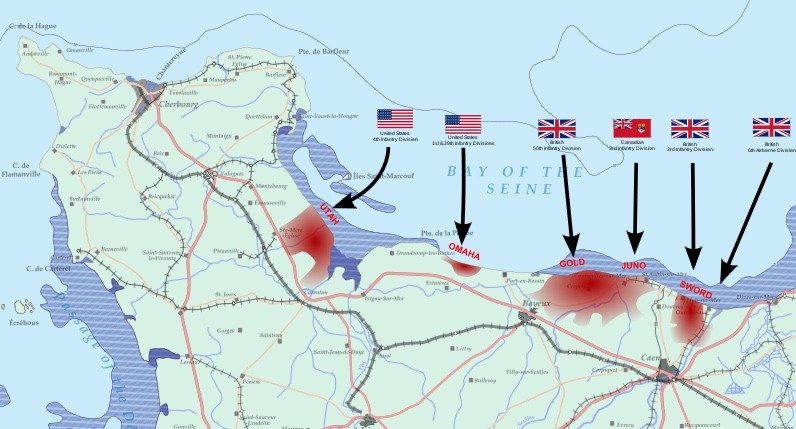
Mistakes would be made on D-Day, as in every military operation before and since. But taken overall, the choice of the specific beaches, the timing of the attack, the overall strategy for the days after, and the commitment of resources, were a triumphant success.
Yet that was by no means certain when the aerial bombing began at:
0300 Hours
Using the almost complete air superiority that had been hard won over the previous months, especially since the P-51 Mustang had started to clear Messerschmitts from the skies of western Europe, Allied bombers began their massive raids against German defenses across Normandy. While the Luftwaffe flew 319 sorties over Normandy that day, the Allies flew 13,688. In all, some 11,500 Allied warplanes of various types took part in D-Day, of which only four were shot down. It was as much of an armada in the air as the naval one that was now dominating the English Channel.
Allied air superiority was an absolute prerequisite for victory. Without it, the Germans could have counterattacked far more powerfully than they did. There is nothing inevitable in history except for German counterattack. It had been seen many, many times in the war already. It would be seen again in the Battle of the Bulge at the end of 1944.
Yet in 1944, while Britain produced 28,000 warplanes and Russia and Germany produced 48,000 each, the United States produced no fewer than 98,000. The extraordinary industrial capacity that allowed America to fulfill President Franklin Roosevelt’s promise of making the U.S. “the arsenal of democracy” was such that whenever a GI saw a plane flying above him on D-Day, there was a 99.2% chance that it would be an Allied aircraft.
* * *
The United States’ ability to turn over its vast industrial might to crush Nazism meant that by 1944 there were no fewer than eighteen shipyards across the country, producing three ships every two days. In southern England, the amount of covered storage space for the supplies needed for D-Day was fifty-seven million square feet. It housed more than 450,000 tons of ammunition.
It was partly the vast size, but also the heavy responsibility of the operation, that reduced one squadron of RAF pilots to utter silence after their briefing. “There was no conversation, no laughter,” wrote one overawed officer. “No one lingered, and we filed out as though we were leaving church. Expressions remained solemn. The task ahead outweighed all our previous experiences and sent a shiver down the spine.”
After a late night with a visiting Hungarian delegation, Adolf Hitler went to bed at the Berghof, his mountain residence in Berchtesgaden. He was not told about the events in Normandy, and his orderly had strict orders not to wake him the next morning.
So the Führer was fast asleep when the armada arrived off the coast of Normandy at:
0400 Hours
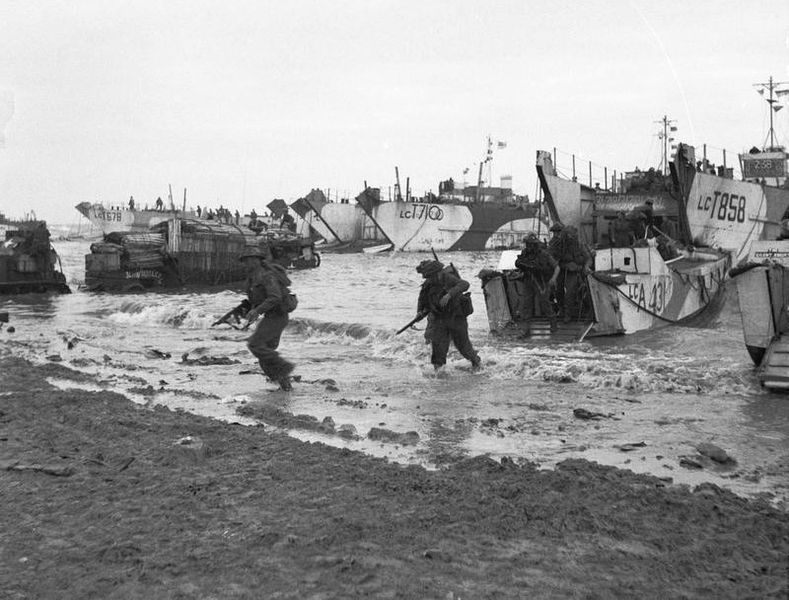
Troops began climbing into their 3000 landing craft. Since the sea was choppy, they were nerve-wrackingly vulnerable. Nonetheless, they made it. The landing craft, most of them designed and built at the Higgins Industries in New Orleans, set off toward the five designated beaches. “You are about to embark upon the Great Crusade, towards which we have striven these many months,” Eisenhower told them.
“The eyes of the world are upon you.” General Bernard Montgomery, commander of Allied land forces, said: “To us is given the honor of striking a blow for freedom which will live in history, and in the better days that lie ahead men will speak with pride of our doings. We have a great and righteous cause.” No one doubted it.
Several senior figures had justified reservations. “It may well be the most ghastly disaster of the whole war,” noted General Sir Alan Brooke. Almost a year before, Churchill had told U.S. War Secretary Henry Stimson, “I see the Channel being full of corpses.” Even the usually cheery and optimistic Eisenhower said to his staff, “I hope to God I know what I’m doing.”
In his tunic Ike kept a resignation letter should the operation fail. The true measure of that great man can be read in its selfless wording:
Our landings in the Cherbourg-Havre area have failed to gain a satisfactory foothold, and I have withdrawn the troops. My decision to attack at this time and place was based on the best information available. The troops, the air and the Navy did all that bravery and devotion to duty could do. If any blame or fault attaches to the attempt, it is mine alone.
The difficulties of putting tanks into the water became apparent at:
0535 Hours
Of the twenty-nine tanks launched into the Channel and destined for Omaha Beach, no fewer than twenty-seven sank in rough seas, and only two got ashore. This made the American assault there all the harder, especially as all twenty artillery pieces sank too, along with the thirteen amphibious trucks carrying howitzers. It was one of many disasters, which had begun with the rehearsal for D-Day undertaken at Slapton Sands in Devon on 29 April 1944. There, seven German torpedo boats killed up to 700 Americans—the exact numbers are still disputed.
Immensely high casualty rates were widely expected. Indeed, D-Day planners anticipated there being around 20,000 killed or wounded. Sapper Captain Logan Scott-Bowden of the Special Boat Section had swum ashore at Omaha Beach in the dead of night back in January to collect sand samples for the planners. He took them to Norfolk House and reported to General Omar Bradley: “Sir, I hope you won’t mind my saying it, but this beach is a very formidable proposition indeed and there are bound to be tremendous casualties.” Bradley put a hand on his shoulder and said, “I know, my boy: I know.”
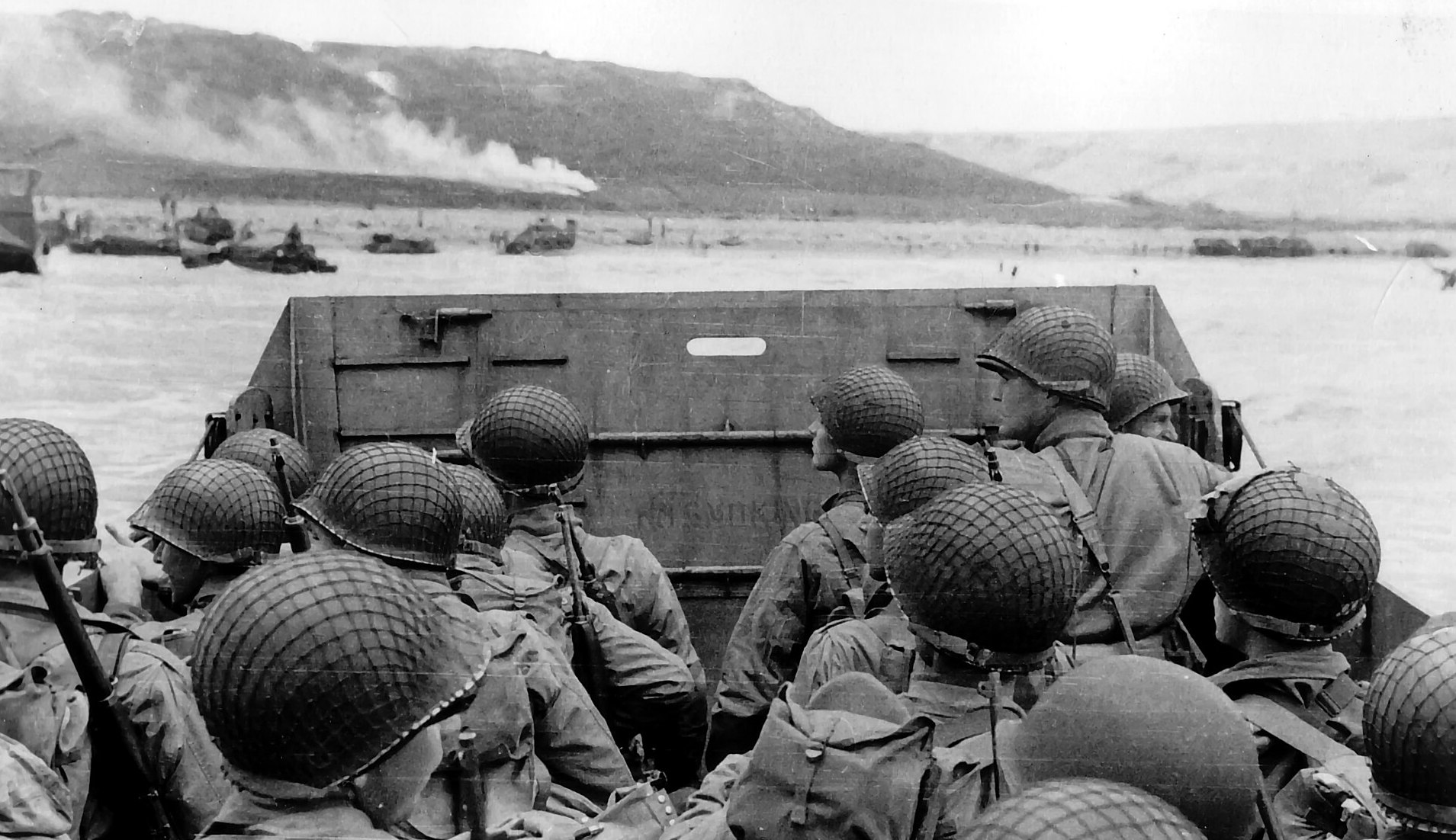
Omaha was, however, the only beach between Utah Beach on the right and the British beaches to the left. There was no alternative if the landings were going to take place in Normandy. “Don’t worry if you do not survive the assault,” one officer jocularly told his men. “We have plenty of backup troops who will just go in over you.”
* * *
With large numbers of paratroopers drowning in flooded fields, more friendly-fire incidents than were officially recorded, and the tank and artillery crews capsizing in heavy waves, many things continued to go badly wrong. General Lesley McNair was killed in a friendly-fire incident that left his body “unrecognisable except for the three general’s stars on his collar.” One plane dropped its paratroopers too low and their corpses were found in a neat line where all had died on impact.
A sergeant reported of the deaths of another eighteen paratroopers as sounding “like watermelons falling off the back of a truck.” Some of the 18,000 paratroopers dropped behind Sword and Utah Beaches landed miles off target. Three-quarters of the three battalions of British sappers who went ashore to clear mines were killed by German machine-gun fire. The fog of war was evident on D-Day, as it is in all wars.
One of the other major failures of the day took place at:
0600 Hours
As dawn approached, the U.S. Eighth Air Force bombed the landing areas at Utah and Omaha Beaches half an hour before troops landed. Thirteen thousand bombs were dropped. They did some damage on Utah, even though bad visibility meant that only sixty-seven of the 360 U.S. bombers were able to discharge their payloads.
At Omaha the situation was far worse. Because they did not want to hit the oncoming armada, the bombers flew in across the beaches rather than along them. So virtually no bombs hit German emplacements on Omaha Beach, meaning that the defenders were ready when the American V Corps went ashore at:
0630 Hours
German machine-gunners wreaked terrible destruction as the landing craft disgorged their men onto Omaha Beach. “Men were tumbling like corn cobs off a conveyor belt,” one sergeant from Wisconsin recalled. The opening scene of the movie Saving Private Ryan captures very well the terror, courage and chaos of the assault, with German mortar-shell explosions turning beach pebbles into grapeshot.
The Americans lost almost 800 men on Omaha alone. No fewer than thirty pairs of brothers killed in Overlord are buried side by side in the cemetery there. Despite the losses, they successfully landed 18,772 men on Omaha and Utah Beaches, once tanks and destroyers finally managed to blast through the defences and the infantry captured the high ground. Some naval guns grew so hot from constant firing that they were continuously hosed down with water.
* * *
Back in Germany, Field Marshal Erwin Rommel, who had returned home for his wife’s birthday party, was woken with news of the attack. He drove to France immediately.
The speed of the German response was further complicated by confusion over who had the right to move the Panzer units stationed in and around Normandy. From February 1944, von Rundstedt (Army Group West) and Rommel (Army Group B) had overlapping commands. Neither had command over the Luftwaffe or Kriegsmarine (German navy). Meanwhile, the anti-aircraft corps stayed under the control of Hermann Göring.
Rommel controlled three Panzer divisions and Rundstedt six. But personal orders from Hitler, who was sleeping, were necessary for their release. Because German army commanders still suspected that the Allied attack might be only diversionary, Hitler was not woken until 10 a.m., when his munitions minister, Albert Speer, arrived at the Berghof.
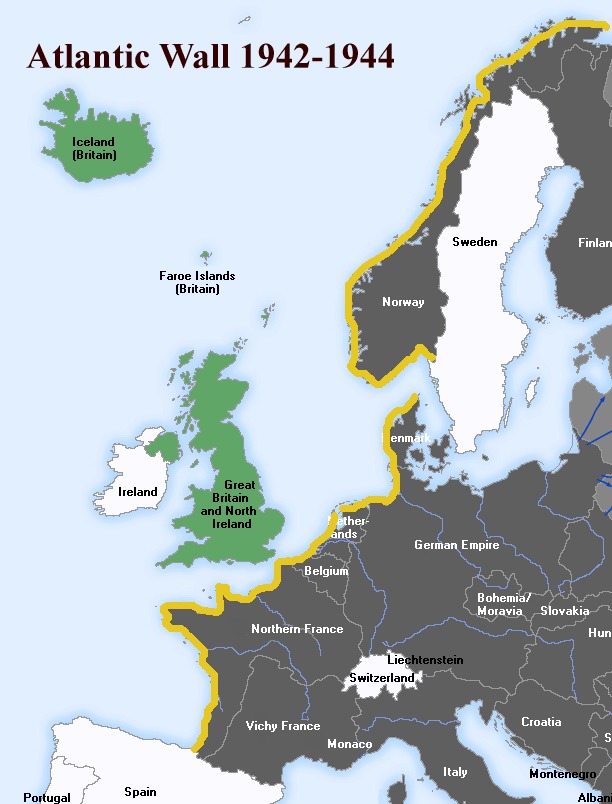
The Allies, despite comprising three major countries on D-Day, had a well-established unity of command under Eisenhower, who was answerable to the combined chiefs of staff. By contrast, the German high command, despite having one Führer, had confusingly overlapping structures and reporting lines.
Hitler also showed a blind faith in the defensive capacities of the Atlantic Wall, built over four years by two million slave laborers. Such faith was perplexing in someone who had so easily outmaneuvered the Maginot Line four years earlier.
0725 Hours
British forces landed at Sword and Gold Beaches, and shortly afterward the Canadians landed at Juno Beach. They met resistance, though not so fierce as at Omaha, and managed to move inland. It is a moot point whether the progress of the British and Canadian forces was ultimately helped or hindered by RAF’s heavy bombers’ systematic destruction of the inland town of Caen, which started at:
1345 Hours
Montgomery had earmarked Caen for capture in the first three days of the campaign, but the town did not fall until 9 July. This might have been in part due to its bombing. The delay gave the Germans ample opportunity to hide their machine-gun nests amid the rubble. Montgomery’s strategy failed at Caen, but the German concentration on it did at least ease the American breakthrough farther west.
Of the 4570 Allied soldiers killed on D-Day, 2500 were American, 1641 British, 359 Canadian, thirty-seven Norwegian, nineteen Free French, twelve Australian, and two New Zealand. Even though the French took little part in the invasion, around 3000 French Resistance fighters did invaluable work in cutting rail lines in some 950 places, which held up Panzer divisions being sent from southwest France.
When, on 4 June, Churchill briefed General Charles de Gaulle, the Free French leader insisted on conditions for his support. Negotiations were heated by the early hours of June 6th, de Gaulle calling Churchill a “gangster” and Churchill calling de Gaulle a “traitor.” Churchill ordered de Gaulle to be sent back to his headquarters in Algiers “in chains if necessary.” It took the best diplomacy from the British foreign secretary, Anthony Eden, to have the order revoked.
De Gaulle first set foot in France on June 14th, and then for only a one-day visit to Bayeux. While he was there, a local cried out, “Vive le Maréchal!”—confusing him with the collaborationist president, Marshal Pétain. “Another person who does not read the newspapers,” de Gaulle muttered to an aide. After his visit to Bayeux, de Gaulle left for Algiers. He did not return to French soil until 20 August, five days before the liberation of Paris.
“We shall probably make another set of mistakes”
Operation Overlord finally blew away the collaborationism that had infected so much of occupied France since its surrender in June 1940. Otto Abetz, Hitler’s envoy to Paris, recalled that of the twenty French politicians who visited him every day in 1940, nineteen would ask for petrol coupons, rationing exemptions, special favors for friends and family, and so on, and only “the twentieth spoke of France.”
The actress Arletty, star of the movie Les Enfants du paradis, had her own way of escaping rationing, by sleeping with a Luftwaffe officer who lived at the Ritz. When she died in 1992, the criticism was not over her collaboration horizontale, but the fact that she and her lover had eaten well during the war while her countrymen had starved. (Ironically enough, the Luftwaffe officer later became a West German diplomat and was eaten by a crocodile while ill-advisedly swimming in the River Congo.)
For all his rows with de Gaulle, and his fears for the success of the operation, Churchill never lost his sense of humour. When a member of Parliament asked him on June 8 to promise to ensure that the same mistakes would not be made after the Second World War as were made after the First, Churchill replied, “That is most fully in our minds. I am sure that the mistakes of that time will not be repeated. We shall probably make another set of mistakes.”
Break-outs from the beaches began at:
1400 Hours
Despite slow progress in the heavy fighting at Omaha Beach, the first exit was cleared there by American forces. On the other four beaches, Allied troops were pushing inland. The Canadians who landed at Juno covered seven miles by end of day and were the only ones to reach all their objectives. (One reason might have been their older average age compared with that of the British and Americans—forty years against twenty.)
However hard the training had been—U.S. Airborne troops had to crawl through hogs’ entrails as part of their toughening-up procedure—it was nothing like actual conflict. As Professor Sir Michael Howard, who won the Military Cross in the Second World War, put it: “No amount of training on the gentle Yorkshire dales could prepare green troops for the ghastly experiences that confronted them when they saw their mates having their heads blown off by shellfire or had to scrape their remains out of brewed-up tanks with mess-tins and spoons.”
Local German counterattacks were well under way by:
1500 Hours
After hours of Hitler’s dithering, and in the face of Allied aerial dominance, the counterattacks were nothing like so effective as had been feared by the planners. The Panzers impeded the invaders’ momentum and kept Caen from falling, but they could not by then drive the Allies back into the sea. At 2015, a German counterattack between Sword and Juno Beaches was halted when the Allies captured the Hillman strongpoint.
The relative lack of Panzer reserves behind the beaches was due partly to an ingenious deception plan, Operation Fortitude. It consisted of two faked attacks, on Norway and the Pas de Calais. “Fortitude North” tied up 372,000 German troops in Norway, while “Fortitude South” kept half a million in the Pas de Calais until June 26th.
Key to Fortitude South was Juan Pujol García, a Spanish double agent who duped the Abwehr (German Intelligence). They believed Garcia was directing twenty-nine sub-agents in Britain. All fictitious, they included a Venezuelan student, a Dutch commercial pilot, a Gibraltarian waiter, merchant seamen, Indians, Canadians, even a Welsh Aryan Nazi.
Garcia was the single most important spy of the Second World War, because it was he who convinced the Germans that the invasion point was the Pas de Calais. (The story was later used by Graham Greene for the plot of Our Man in Havana.)
So successful was García—codenamed “Garbo” by his MI5 handlers because he was “the world’s best actor”— that the Germans were continuing to reinforce the Pas de Calais even long after D-Day instead of committing their full resources to countering the Normandy landings.
* * *
On top of Garcia’s efforts, a fake First U.S. Army Group was created. Made up of dummy tanks and aircraft and stationed across the Channel from Calais under the command of General George S. Patton, it was visited by King George VI. The Germans could not believe that Patton, the best tank commander of the U.S. Army, would not be in a key position in the invasion. In order to continue the ruse, an actor posing as Montgomery was also sent to Gibraltar.
To keep the invasion secret, all diplomats in the weeks prior to the operation were prevented from leaving Britain. Military leave was canceled, movement around southern England was banned, and even the postal service stopped. Not a word leaked.
1720 Hours
The situation on Omaha Beach was now such that wheeled and tracked vehicular traffic was possible on most of the area below the high-water mark. A relieved General Leonard Gerow, the commander of V Corps, proceeded to set up his headquarters ashore. By midnight on that “longest day” the Allies had landed more than 156,000 men in Normandy by air and sea who could not now be dislodged from their beachheads. More than two million men would follow them to the Continent over the next three months.
Once troops were ashore, the fighting in the hedgerows of the Norman bocage was immensely fierce. Anglo-American losses after D-Day ran at 2000 per division per month. The bodies in the hedgerows became so swollen that the burial teams had to knee them in the back to release the gas before they could be taken away for burial.
The story of the American breakout from Normandy and the wholesale slaughter of the German armies in the Falaise Gap has been well told by distinguished historians such as Stephen Ambrose, Antony Beevor, Peter Caddick-Adams, Carlo D’Este, Martin Gilbert, Max Hastings, and John Keegan.
Churchill’s appreciation
The way to Paris was now open. On 2 August Churchill praised the soldiers of D-Day, including his American allies:
It is the wish and also the desire of General Eisenhower that the battle for Normandy should be viewed as a whole and as one single set of operations conducted by an Allied Force, linked in brotherhood and intermingled in every manner that may seem convenient.
But this should certainly not prevent the British House of Commons from expressing its unstinted admiration for the splendid and spectacular victories gained by the United States troops under General Bradley, both at Cherbourg and in the southward march, now become almost a gallop down the peninsula. The Germans have certainly had remarkable opportunities of revising the mocking and insulting estimate which they put upon the military value of the American Army at the time they declared war upon the great Republic.
We British and Canadians too have taken our full share in these fierce and prolonged conflicts. We have fulfilled the indispensable part which was assigned to us by the Supreme Commander and, under him, by General Montgomery…. British and Canadian Forces together are about equal to those of the larger United States Army in proportion to their relative strength. It has been share and share alike, in good fortune and bad, all along the front.
Eighty years on
D-Day represents the greatest single service that the English-Speaking Peoples rendered civilization. Although it took almost another year to extirpate Nazism, Hitler’s downfall was now certain. Montgomery predicted that future generations would speak with pride of the men who undertook that effort, and he was right.
Yet are we not also in a sense mocked by the doings of the Greatest Generation on D-Day? Although Eisenhower’s language about a “crusade” might not pass modern inclusivity or sensitivity tests, was not the certainty of their belief in the superiority of democracy and liberty and the benefits of Western civilization something noble, and something we are in the process of busily throwing away?
They knew what was worth fighting and dying for, whereas today we seem to be unsure of everything, even down to the pronouns we should use for one another. The men who stormed the beaches of Normandy knew that they had nations behind them that would keep them in ammunition till they bearded the Nazi beast in its lair.
* * *
By stark contrast, the United Kingdom today barely has enough 155mm shells to defend itself for three days. Its military capacity has been entirely hollowed out, and the Royal Navy numbers nineteen surface warships despite forty-one admirals. Britain will not even allow the inflatable small boats used by illegal immigrants to cross the English Channel to be given to the Ukrainian army to cross the Dnieper River because, the government says, they are “unseaworthy.”
Meanwhile, the United States is slicing back its navy just as the world gets ever more dangerous, and intellectuals and journalists sneer at the “special relationship” between the United Kingdom and the United States, and Canada, that provided such comradeship and support for the soldiers of the Second World War.
The men of D-Day had leaders such as Winston Churchill and Franklin Roosevelt. We were handed a fine inheritance by the Greatest Generation, which we have squandered, frittering away our moral superiority through an obsession with the (undoubted) crimes of centuries ago.
Faced with the essentially Nazi ideology of Hamas—whose sole object is to complete in the Middle East what Adolf Hitler nearly achieved in Europe—we crave cease-fires, hypocritically lecture Israel on “proportionality” and embargo her armaments, repeat Hamas propaganda on casualty figures, and allow students to terrify innocent Jews on our university campuses.
Similarly, faced with a totalitarian Russian dictator, the isolationist heirs of Charles Lindbergh seek to deny Ukraine the weapons she desperately needs to defend herself. What moral pygmies we are compared with the giants of eighty years ago. We salute the Greatest Generation on this anniversary, while we shame their sacrifice and shun their example.
The author
Andrew Roberts, Lord Roberts of Belgravia, is Visiting Professor at the Department of War Studies at King’s College, London; the Bonnie and Tom McCloskey Visiting Research Fellow at the Hoover Institution at Stanford University; and a contributor to the Hillsdale College Churchill Project. His Churchill: Walking with Destiny (2018) was acclaimed as “undoubtedly the best single-volume life of Churchill ever written” (Sunday Times). His latest book, with General David Petraeus, is Conflict: The Evolution of Warfare, 1945 to Ukraine, (London: HarperCollins). Again, our thanks to the author and National Review for permission to excerpt his essay.