
Subscribe now and receive weekly newsletters with educational materials, new courses, interesting posts, popular books, and much more!
Articles

“Equal Justice”: What Churchill Told the Arabs in 1921
No Comments
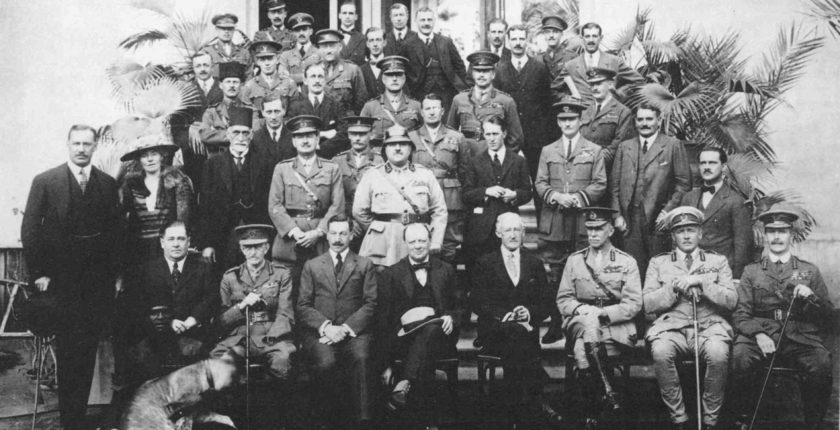
The Middle East Conference, Cairo, March 1921. This is the most thorough identification of people in a famous photograph, but we welcome more. Seated L-R: Malcolm Stevenson (Cyprus High Commissioner), Gen. Walter Congreve (Commander Egyptian Expeditionary Force), Sir Herbert Samuel (Palestine High Commissioner), Winston Churchill (Colonial Secretary), Sir Percy Cox (Iraq High Commissioner), Gen. Alymer Haldane (British Commander Mesopotamia), Gen. Edmund Ironside (Churchill’s choice for Iraq commander), and General Percy Radcliffe (War Office). Second row, L-R: Sir Geoffrey Archer (Governor British Somaliland), Gertrude Bell (Middle East Dept.), Sir Sassoon Eskell (Iraq Finance Minister), “Gen. Atkinson” (?), Jafar Pasha al-Askari (Iraq Defense Minister), T.E Lawrence (Middle East Dept.), Gen. John Salmond (RAF Iraq), Lt. Col. Arthur Trevor (British Resident), Hubert Young (Middle East Dept.). Extreme top, center in bow tie: Sir Archibald Sinclair (Colonial Office Private Secretary). Below Sinclair, also in bow tie: Joseph Crosland (War Office Finance Director). Foreground: two lion cubs on their way from Somaliland to London Zoo. (Hillsdale College Press)
The Cairo Conference
Many are aware that Churchill’s Complete Speeches (1974) are not complete. Occasionally an omission is discovered that sheds new light on important subjects. This one, from 1921, relates to Churchill’s words on a century-old conflict over the part of Mandatory Palestine that became Israel.
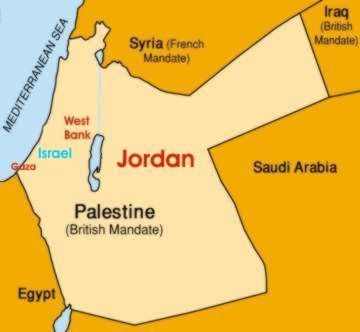
Churchill became Colonial Secretary in February 1921. His first assignment was to reorder the Ottoman Empire, wrested from the Turks during the First World War. In March he convened the Cairo Conference, with side meetings in Jerusalem, to settle new borders in the Middle East .
Arab nationalism was in the air, and Cairo placed Arab kings on the thrones of Iraq and Jordan (East Palestine). In West Palestine (what is now mostly Israel) a British administration was installed, promising fair play and eventual self-government for Arabs and Jews. That act, well-meaning and optimistic though it was, laid the groundwork for endless strife.
Jerusalem, 1921
Churchill’s Jerusalem statement urging moderation to the Arab Delegation is only briefly excerpted in the Complete Speeches.1 In 2017, however, the Israeli scholar and diplomat Lenny Ben-David unearthed what may be the complete transcript, below.2 It helps us to understand Churchill’s thoughts and hopes that Arabs and Jews could coexist in the Palestine. Churchill began:
I consider your address partly partisan and incorrect.3 You have asked me in the first place to repudiate the Balfour Declaration and to veto immigration of Jews into Palestine. It is not in my power to do so, nor, if it were in my power, would it be my wish. The British Government have passed their word, by the mouth of Mr. Balfour, that they will view with favour the establishment of a National Home for Jews in Palestine, and that inevitably involves the immigration of Jews into the country.
This declaration of Mr. Balfour and of the British Government has been ratified by the Allied Powers who have been victorious in the Great War; and it was a declaration made while the war was still in progress, while victory and defeat hung in the balance. It must therefore be regarded as one of the facts definitely established by the triumphant conclusion of the Great War.
It is upon this basis that the mandate has been undertaken by Great Britain, it is upon this basis that the mandate will be discharged. I have no doubt that it is on this basis that the mandate will be accepted by the Council of the League of Nations, which is to meet again shortly.
Good for all…
Churchill then defended the Jews’ long association with Palestine. Optimistically, he insisted that the two religions could coexist:
Moreover, it is manifestly right that the Jews, who are scattered all over the world, should have a national centre and a National Home where some of them may be reunited. And where else could that be but in this land of Palestine, with which for more than 3000 years they have been intimately and profoundly associated?
We think it will be good for the world, good for the Jews and good for the British Empire. But we also think it will be good for the Arabs who dwell in Palestine, and we intend that it shall be good for them, and that they shall not be sufferers or supplanted in the country in which they dwell or denied their share in all that makes for its progress and prosperity.
And here I would draw your attention to the second part of the Balfour Declaration, which solemnly and explicitly promises to the inhabitants of Palestine the fullest protection of their civil and political rights.
Who liberated Palestine?
Through 1948, amidst many rejected plans for condominium or separate states, Churchill continued to remind Arabs of who had liberated their lands:
After all, the British Government has a view of its own in this matter, and we have right to such a view. Our position in this country is based upon the events of the war, ratified, as they have been, by the treaties signed by the victorious Powers.
I thought, when listening to your statements, that it seemed that the Arabs of Palestine had overthrown the Turkish Government. That is the reverse of the true facts. It has been the armies of Britain which have liberated these regions. You had only to look on your road here this afternoon to see the graveyard of over 2000 British soldiers, and there are many other graveyards, some even larger, that are scattered about in this land.
The position of Great Britain in Palestine is one of trust, but it is also one of right. For the discharge of that trust and for the high purposes we have in view, supreme sacrifices were made by all these soldiers of the British Empire, who gave up their lives and their blood. Therefore I beg you to realize that we shall strive to be loyal to the promises we have made both to the Arab and to the Jewish people, and that we shall fail neither in the one nor in the other.
A home or a state?
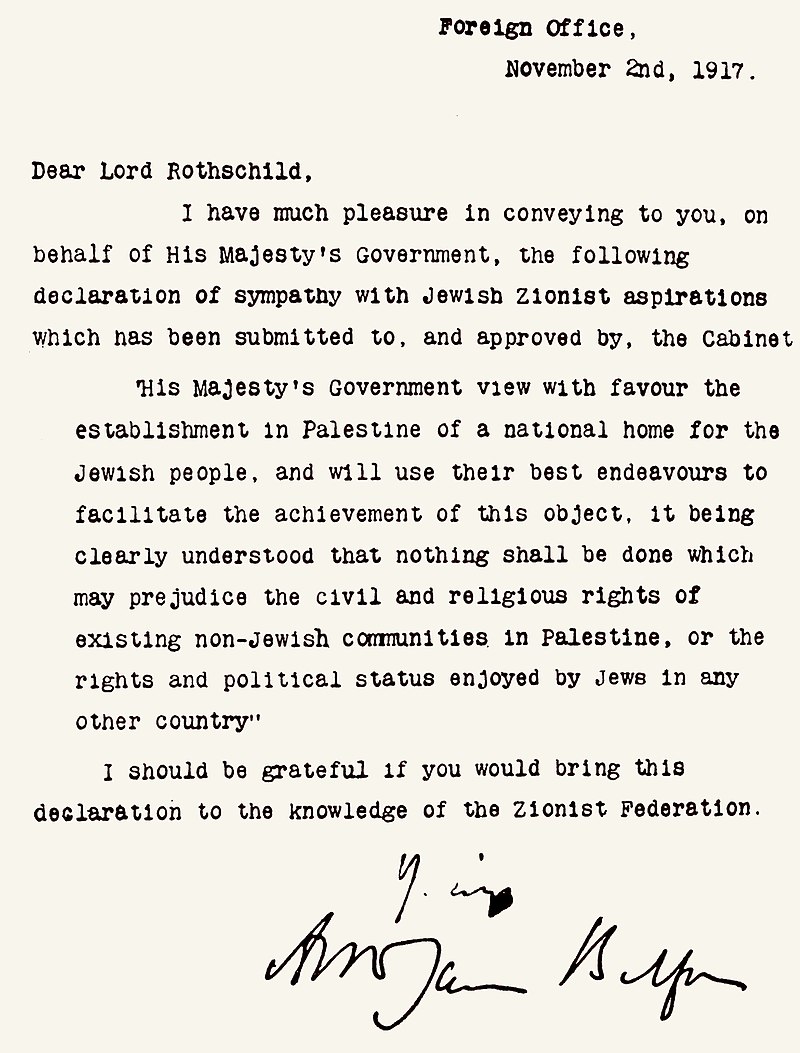
There is confusion over what the Balfour Declaration promised. It was a Jewish homeland not a state. Repeated efforts would be made to produce a state. When that was rejected, partition was offered, and also rejected:
I would also draw your attention to the very careful and exact nature of the words which were used by Mr. Balfour. He spoke of “the establishment in Palestine of a National Home for the Jews.” He did not say he would make Palestine the National Home for the Jews. There is a difference between the two which is of great importance. The fact that Palestine shall contain a National Home for the Jews does not mean that it will cease to be the National Home of other people, or that a Jewish Government will be set up to dominate the Arab people.
On the contrary, the British Government is well disposed towards the Arabs in Palestine, and, indeed, cherish a strong friendship and desire for co-operation with the Arab race as a whole. That is what you would expect from the British Empire, which is the greatest of all the Moslem States in the world, and which must never cease to study the needs and wishes of its Moslem subjects and allies; and surely you have found that—at any rate I have been assured on this point by many Moslems since my arrival here—in the daily contact with the officers of this Administration in Palestine: that they make no distinction as between Arab and Jew, and that they endeavour in every way to render impartial, even-handed justice.
His listeners said Churchill dissembled and was too glib. Today’s conclusions must be left to the reader. See also Palestine Timeline 1945-46.
The High Commissioner
Here was a piece of verbal gymnastics which must have been noticed by the 1921 Arab delegation. Although High Commissioner Sir Herbert Samuel governed with moderation, his religion was a potential sticking point despite Churchill’s high opinion:
We regard this matter of such importance that we moved his Majesty the King to appoint Sir Herbert Samuel as High Commissioner. He has held very high office in our own country, and he has many years’ experience in our Parliamentary and Cabinet life. Therefore in selecting him we knew we had a trained and experienced man who would understand what ought to be done and what the full meaning and purpose of British policy was.
Moreover, he is himself a Jew, and therefore we knew that in holding the balance even and securing fair treatment for all he could not be reproached for being hostile to his own people, and he would be believed by them when he said that he was only doing what was just and fair; and I think this appointment has been vindicated and justified not only by what has been done but by its results.
I do not think you have any need to feel alarmed or troubled in your minds about the future. The British Government has promised that what is called the Zionist movement shall have a fair chance in this country, and the British Government will do what is necessary to secure that fair chance. But after all it is only upon its merits that Zionism can succeed. We cannot tolerate the expropriation of one set of people by another or the violent trampling down of one set of national ideals for the sake of erecting another.
A benefit to all
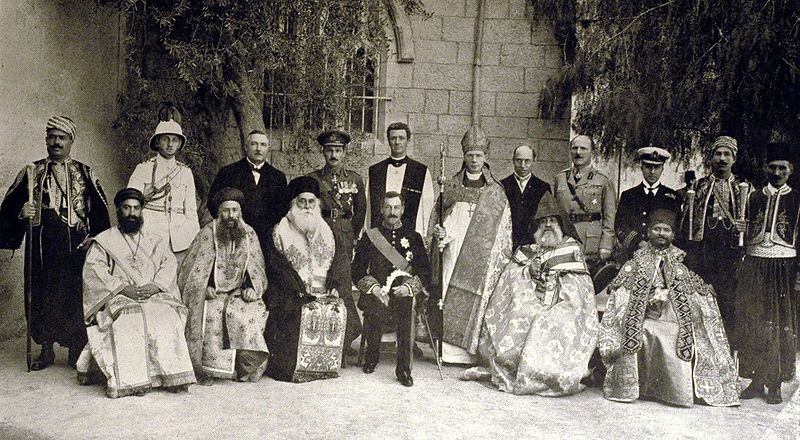
Churchill consistently maintained that Jewish accomplishments in West Palestine, such as irrigation, were a boon to all inhabitants. Despite his sincerity and optimism, this proved to be a hard sell:
If a National Home for the Jews is to be established in Palestine, as we hope to see it established, it can only be by a process which at every stage wins its way on its merits and carries with it increasing benefits and prosperity and happiness to the people of the country as a whole. And why should this not be so? Why should this not be possible?
You can see with your own eyes in many parts of this country the work which has already been done by Jewish colonies; how sandy wastes have been reclaimed and thriving farms and orangeries planted in their stead. It is quite true that they have been helped by money from outside, whereas your people have not had a similar advantage, but surely these funds of money largely coming from outside and being devoted to the increase of the general prosperity of Palestine is one of the very reasons which should lead you to take a wise and tolerant view of the Zionist movement.
Palestine under the Turks
With dripping sarcasm, Churchill attacked the Arab delegation’s argument that Ottoman rule had been a blessed era. Here he was on more convincing ground:
The paper which you have just read painted a golden picture of the delightful state of affairs in Palestine under the Turkish rule. Every man did everything he pleased; taxation was light; justice was prompt and impartial; trade, commerce, education, the arts all flourished. It was a wonderful picture. But it had no relation whatever to the truth, for otherwise why did the Arab race rebel against this heavenly condition?
Obviously the picture has been overdrawn. And what is the truth? This country has been very much neglected in the past and starved and even mutilated by Turkish misgovernment. There is no reason why Palestine should not support a larger number of people than it does at present, and all of those in a higher condition of prosperity.
The promise of the future
Churchill attempted to assure the Arabs who feared Zionist immigration:
But you will say to me, are we to be led by the hopes of material gain into letting ourselves be dispossessed in our own house by enormous numbers of strangers brought together across the seas from all over the world? My answer is; no, that will not be, that will never be. Jewish immigration into Palestine can only come as it makes a place for itself by legitimate and honourable means; as it provides the means by which it is to be supported. The task before the Zionists is one of extraordinary difficulty.
The present form of government will continue for many years, and step by step we shall develop representative institutions leading up to full self-government. All of us here to-day will have passed away from the earth and also our children and our children’s children before it is fully achieved. The Jews will need the help of the Arabs at every stage, and I think you would be wise to give them your help and your aid and encourage them in their difficulties.
“A difference in the life you have lived…”
Insisting that Zionists would not dominate was a tough sell, but Churchill tried:
They may fail. If they are not guided by wisdom and good will, if they do not tread the path of justice and tolerance and neighbourliness, if the class of men who come in are not worthy of the Jewish race, then they will fail and there will be an end of the experiment.
But on the other hand, if they succeed, and in proportion as they do succeed year by year, such success can only be accompanied by a general diffusion of wealth and well-being among all the dwellers in Palestine and by an advance in the social, scientific and cultural life of the people as a whole.
These are words which I speak to you with great belief in their truth. I am sure if you take my advice you will not find in the future any difference in the life you have led in the past, or in the part you have played in your country, except an improvement. There will be more food, there will be more freedom, there will be more people, there will be more health among the people, there will be more knowledge, the fruits of toil will be more securely enjoyed, and the harvests will be more fully reaped by those who have sown them. Above all there will be a complete respect for everyone’s religious faith.
“Palestine belongs to the world”
Churchill liked to quote a famous line by Bourke Cockran, his Irish-American mentor: “The earth is a generous mother….” He did so over Ireland, during his Depression-era American lecture tour, at his “Iron Curtain” speech in 1946—and to his 1921 Arab audience in Jerusalem:
Although the Arabs are in a large majority in Palestine and although the British Empire has accepted the mandate for Palestine, yet in a certain wider sense Palestine belongs to all the world. This city of Jerusalem itself is almost equally sacred to Moslem, Christian and Jew—not only those who dwell in this land, but those of these three religions who all over the world look to what is the holy centre of their faith.
The Arabs of Palestine have therefore a great trust which we look to them to discharge and to help us (the British Government) in discharging, and just as in the spiritual sphere the profession of one faith does not mean the exclusion of another, so in the material world there is room for all.
If instead of sharing miseries through quarrels you will share blessings through cooperation, a bright and tranquil future lies before your country. The earth is a generous mother. She will produce in plentiful abundance for all her children if they will but cultivate her soil in justice and in peace.
Questions to ponder
Churchill in 1921 was attempting to sell an agreement hammered out in Cairo to the Arabs of West Palestine. One may argue that was too dismissive of real problems. If in 1921 he was speaking for all of Palestine, did he realize that Jews would be excluded from the six-sevenths of it which became Jordan? Did he know or suspect that continued Jewish immigration would eventually rival the Arab population in the other seventh?
By the late Thirties, the two populations of West Palestine had reached an impasse. From 1937 to 1948, seven “two-state solutions” were proposed and rejected by the Arabs, and sometimes the Zionists as well. The first Arab-Israeli war broke out in 1948. Churchill supported the founding of the state of Israel, but there was no hiding his disappointment. Thirty years after 1921, in the uneasy peace following 1948, he could only express sadness over “the mistakes and miscalculations in policy which led to the winding up of our affairs in Palestine in such a way as to earn almost in equal degree the hatred of the Arabs and the Jews.”4
Endnotes
1 Winston S. Churchill (hereinafter WSC), “Justice for Arab and Jew,” reply to the Muslim Delegation, Government House, Jerusalem, 31 March 1921, in Robert Rhodes James, ed., Winston S. Churchill: His Complete Speeches 1897-1963 (New York: Bowker, 1974), 8 vols., III: 3083-84.
2 Lenny Ben-David, “Winston Churchill’s Defense of the Balfour Declaration in 1921,” Jerusalem Center for Security and Foreign Affairs (JCFA), Jerusalem, 27 February 2017, accessed 5 November 2024.
3 WSC, 31 March 1921, Complete Speeches III: 3084-85. This first sentence of his 1921 letter is the only sentence omitted in the text quoted by Mr. Ben-David.
4 WSC, “The Middle East Situation,” House of Commons, 30 June 1951, in Complete Speeches, VIII: 8232-33.
Related reading
David Fromkin, “The Modern Middle East: How Much is Churchill’s Fault?” 2023.
Richard M. Langworth, “Timeline: Winston Churchill on Palestine, 1945-46,” 2023.
______ ______, “Timeline: Winston Churchill and the Road to Israel, 1947-49,” 2023.
______ ______, “Great Contemporaries: T.E. Lawrence, No Greater Churchillian,” 2020.
William J. Shepherd, “1921, A Watershed Year Brilliantly Recounted by David Stafford,” 2020.