
Subscribe now and receive weekly newsletters with educational materials, new courses, interesting posts, popular books, and much more!
Articles

Anthony Tucker-Jones on the Selling Out of Eastern Europe
No Comments

An obviously ailing Roosevelt with Churchill at Yalta. WSC wrote: “The President seemed placid and frail. I felt that he had a slender contact with life. I was not to see him again.” (Wikimedia Commons)
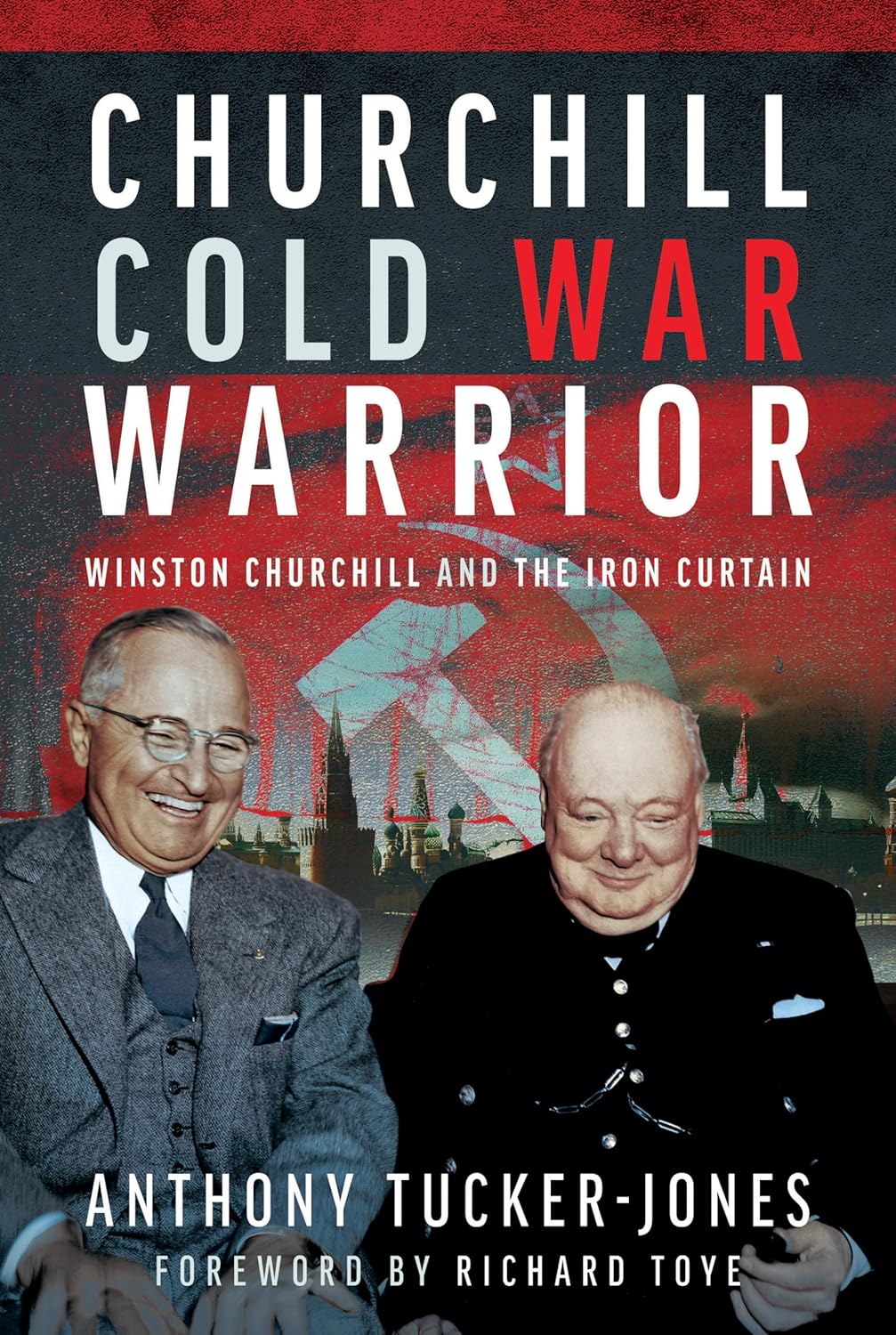
Anthony Tucker-Jones, Churchill Cold War Warrior: Winston Churchill and the Iron Curtain (Yorkshire and Philadelphia: Frontline, 2024), 224 pages, $49.95, Amazon $30.21, Kindle $29.99.
Anthony Tucker-Jones is a former British intelligence officer and military historian with over sixty books to his credit. His first volume on Churchill, Master and Commander: Winston Churchill at War 1895-1945 (2021), was positively reviewed by this writer. There was some criticism over why he stopped in 1945. It is not clear if this new work, which takes Churchill through to his retirement in 1955, is a response or a planned culmination.
Discerning readers will note the foreword by historian Richard Toye, no admirer of Churchill. This might suggest what is to come. Like Tucker-Jones’s last book, this is a well written and researched work, limited by similar date and factual errors. Some of its historical interpretations might raise an eyebrow, but one bald thesis of Cold War Warrior is more of a jaw drop. This comes early, in the waning days of the Second World War.
A plunge into swampland
 Churchill’s hatred of Communism is well-known. He also recognized that Russia had essential if not always predictable national interests. Therefore, he never saw Soviet Russia, and later Communist China, in the same light as Nazi Germany, which he considered beyond negotiations.
But Tucker-Jones veers into historical swampland by asserting that Churchill’s 1946 “Iron Curtain” speech at Fulton, Missouri, was “paradoxical,” if not “hypercritical” (ix). The author claims that he sold Eastern Europe to Stalin in the 1944 “Percentages Agreement” with Stalin in Moscow—long before the ailing Roosevelt in 1945 at Yalta (“the Riviera of Hades”) as Churchill called it (13).
After the war, Churchill is commended for restraining American bellicosity, but condemned for never admitting that the “Iron Curtain” was as much his creation as Stalin’s (xvi). Tucker-Jones generates more heat than light over the “Percentages Agreement,” which Churchill considered a wartime expedient.
As eastern Europe was liberated from the Nazis, Churchill proposed that the Anglo-Americans would be paramount in Greece and the Soviets in Poland and the Balkans. Given the Red Army’s preponderance in those lands, many observers concluded that Churchill was doing the best he could, and in 1945, it did save Greece. Not Mr. Tucker-Jones.
Instead he argues that Churchill “foolishly sowed the seeds for the Cold War” (4). He adds that Churchill had failed both Greece and Poland before. He means Britain’s failure to stop Hitler’s invasion of Greece in 1941; but how Churchill was responsible for Poland in 1939 in unclear.
Postwar opposition
Except for blaming Churchill for the Cold War, Tucker-Jones otherwise presents a rather conventional account of WSC’s years in opposition to the 1945-51 Labour government. Churchill wrote much of his Second World War memoirs in those years. He also gave historic speeches warning of Soviet Communism and advocating European unity.
There are excellent chapters on the bloody travails of decolonization in India and Palestine; diplomatic and sometimes shooting conflicts with Egypt and Iran; Communist assaults in Korea; and an insurgency in Malaya. While critical of Labour’s “scuttle” from Empire, as he put it, Churchill generally backed Labour’s foreign and military efforts, including the Berlin Airlift and founding of NATO. He also approved of the Labour government’s efforts to make Britain a nuclear power, a process he completed in 1952.
An aging but still active Churchill leading the Tories narrowly lost the February 1950 election. A week before the vote, it was rumored that Churchill had died! His family was unamused, but WSC addressed it with his usual mischievous aplomb: “[A] rumour has been put about that I died this morning. This is quite untrue…. It would have been more artistic to keep this one for Polling Day” (98).
Return to power
He finally returned to Downing Street as Prime Minister and Minister of Defence in October 1951, just shy of his 77th birthday. Tucker-Jones says this was Churchill’s seventeenth election (102). It was in fact his nineteenth, with two more to come.
Except for reminders that he started the Cold War, the account of Churchill’s second premiership is conventional, and represented as “ lackluster” (220). His diplomacy focused on tightening the alliance with the United States, first with Truman, then after 1952 with Eisenhower. Financial support was more forthcoming than Churchill’s aim, if not dream, of settling the Cold War, particularly after Stalin’s death in 1953. Neither the Americans nor his Cabinet put much stock in his endeavor for “a meeting at the summit.” His disappointment at being unable to forge a lasting peace lasted through his 1955 retirement, and beyond.
He did have success in substantially ending the rebellion in Malaya and containing others in Cyprus and Kenya. The Americans helped settle conflict with Iran but were unhelpful over Egypt. The Suez Crisis would explode in 1956 under Churchill’s successor, Anthony Eden. Tucker-Jones credits Churchill with restraining Eisenhower over the possible use of nuclear weapons to settle conflicts in Korea and Indochina. We might question how much influence he and Britain had by then.
***
This is not a bad book, despite its highly debateable perception of the origins of the Cold War. The sourcing is impressive, with endnotes, bibliography, a Cold War timeline, thirty-six black and white illustrations and ten maps. An annoying element is the lack of explanation regarding the roles of Anthony Eden and Selwyn Lloyd (62, 137, 149-150, 170). The author tends to conflate Ministers of State (Lloyd), with Secretaries of State (Eden)—there is a difference.
The author also skips over Eden’s term as Secretary of State for War when first joining Churchill’s wartime cabinet (May-December 1940). Eden then succeeded Halifax as Foreign Secretary (xiii). There are also errors in stating Churchill was 81 rather than 80 when he left office (150) and contrary to one photo note, Macmillan became PM in 1957 not 1956.
The author
William John Shepherd, archivist and historian, is a long-time contributor to The Churchill Project, several academic journals, and popular history magazines.