
Subscribe now and receive weekly newsletters with educational materials, new courses, interesting posts, popular books, and much more!
Articles

“Opium for the People”: The Myth of Firebombing the Black Forest

Wellington bombers of No. 9 Squadron, Royal Air Force. (RAF, public domain)
Churchill as Mad Bomber (again)
The Internet bubbles again with that old time religion: Winston Churchill, graduate Germanophobe, ensured today’s troubled world by stubbornly refusing to stop fighting Hitler.
The idea is not new. Churchill’s sin was featured in Francis Neilson’s The Churchill Legend (1954). Cambridge’s Maurice Cowling added The Impact of Hitler (1975)—enthusiastically endorsed by Alan Clark, MP. David Irving gave us the misunderstood Führer in Churchill’s War (1987). Ralph Raico produced “Rethinking Churchill” (Mises Institute, 1990). John Charmley’s Churchill: The End of Glory (1993) channeled Cowling, within a thoughtful appraisal of Churchill’s whole career. Pat Buchanan piled on with Churchill, Hitler and the Unnecessary War (2008). Curiously, all these critics were from the right, where Churchill is often deemed to reside.
So the vision of Churchill as maximum villain is longstanding. What is new is its viral appearance in an interview by popular podcaster, Tucker Carlson, who has an unprecedented reach on YouTube and the worldwide web.
Adolf Hitler was just misunderstood, argues the “historian” interviewed, Mr. Darryl Cooper. He only invaded Poland because Chamberlain and Churchill forced him. He never wanted to conquer France. No sooner had he done so than the Luftwaffe dropped peace leaflets on Britain. The Germans were baffled over what to do with millions of Russian prisoners because Churchill kept fighting long enough to bring Stalin in. (Hence the death camps.) Then Churchill got America involved. The result was fifty million dead and fifty years of Cold War.
Pushback to this has been massive—most expertly by the historian Victor Davis Hanson. Here we consider just one of Mr. Cooper’s unique charges: that in his bloodlust, Churchill firebombed Germany’s Black Forest. (We hadn’t heard that one before.)
Black Forest redux
Everybody likes trees. Churchill himself said, “No one should ever cut one down without planting another.”1 Inevitably, the charge that he wiped out a forest in a burst of impulsive firebombing tugs at the heartstrings. But did he?
To be scrupulously accurate, here is an exact transcription of the charge in question:
[Churchill] was literally by 1940 sending firebomb fleets to go bomb the Black Forest, just to burn down sections of the Black Forest. Just rank terrorism, you know, just going through what eventually became saturation bombing, carpet bombing of civilian neighborhoods, you know, the purpose of which was to kill as many civilians as possible. And all the men, the fighting age men, were out in the field. So this was old people, women and children, and they were wiping these places out as gigantic-scale terrorist attacks, of a scale you’ve never seen in world history.
Get it? Nobody was left in the Black Forest but women, children and the aged. Winston Churchill was bent on wiping them out. Now let’s look at the facts.
Bombing “private property”
In mid-August 1939, Churchill and General Louis Spears visited France as private Members of Parliament. Spears recalled: “We gazed across the Rhine at the immense Black Forest which, the French told us, was full of ammunition dumps. Loaded convoys were for ever driving into its depths and coming out empty.”2
The Black Forest (Schwarzwald) in southwest Germany spans 2300 square miles (roughly 100 by 30). Rich in timber and ore deposits, it has been fortified since the 17th century. In 1939-40 it housed the Wehrmacht High Command (OKW), Hitler’s headquarters after France surrendered.3 So much for the vision of bucolic timberland populated by aged civilians, women, children and clockmakers.
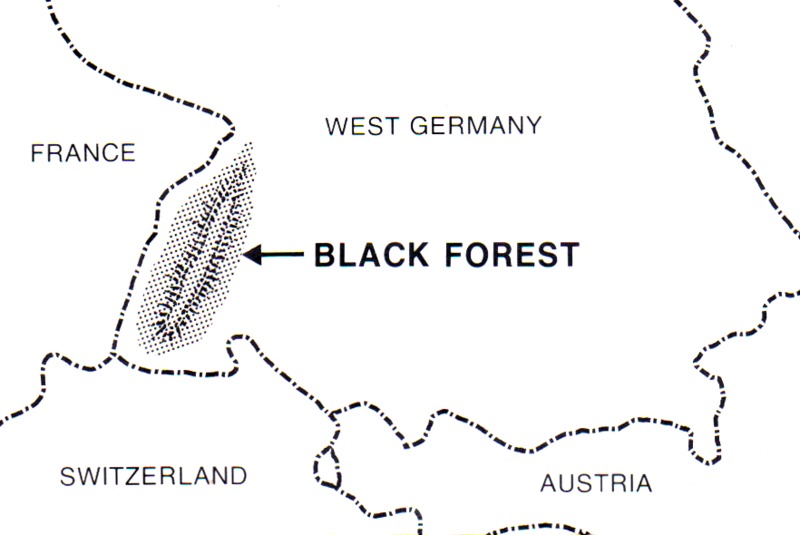
When war was declared, General Spears and Leopold Amery urged Chamberlain’s Air Minister, Sir Kingsley Wood, to bomb Black Forest ammunition dumps. Amery, wrote Spears,
was well aware that that vast wooded area was packed full of munitions and warlike stores. He suggested we should immediately drop incendiary bombs on to it. It had been a very dry summer, he pointed out, and the wood would burn easily, but the rain might come at any moment and a unique chance might be lost, probably for ever. Kingsley Wood turned down the suggestion with some asperity. “Are you aware it is private property?” he said. “Why, you will be asking me to bomb Essen next!”4
This, continued Spears, threw “astounding light on the mentality of Munichers [Chamberlain ministers] at war…” Woods’s “private property” remark was later quoted without elaboration by Harold Macmillan, William Manchester and Lynne Olson.5
What Kingsley Wood actually said
Unlike the above writers, the historian John Charmley dug deeper: “In fact, Sir Kingsley actually told Amery that the Government would not bomb civilian areas for fear of alienating American opinion, which was a perfectly sensible answer; but any stick would do to beat the appeasers.”6
Amery in his diaries did refer to Woods’s “private property” remark7. But Charmley had read further, and noticed that Amery had second thoughts:
I think also mentioned the fact that they had munition dumps there, though my main argument was to deprive them of timber. I cannot remember whether [Sir Kingsley] spoke about it being private property, but if he did it may well have been in order to put me off the fact that the French were desperately anxious to have nothing to do with bombing till their own anti-aircraft defences were better…. What I do remember was that I was very indignant, for it seemed to me essential on moral grounds, if on no others, that we should try and do something to help the Poles.8
Ah, the Poles! Remember them? Lost in the recent podcast was the fact that Poland was being systematically obliterated by Hitler’s Wehrmacht. The Poles had been “guaranteed” by Chamberlain—without military means to do so: a decision, Churchill wrote, “taken at the last possible moment and on the least satisfactory ground, which must surely lead to the slaughter of tens of millions of people.”9
Amery’s sympathy for the Poles is perfectly understandable. If we were not present at that time, we should at least try to put ourselves into the shoes of those who were.
“Not how Churchill waged war”
Even with Churchill in the Chamberlain government, wrote the press baron Cecil King, there was little appetite for offense during 1939: “Many plans were debated—and rejected: floating mines down the Rhine; setting the Black Forest on fire; bombing Russian oil wells in Baku (to stop Hitler getting the oil); even sending an expeditionary force to aid the embattled Finns.”10
The Chamberlain government’s reluctance, Charmley wrote, “was all part of the Allied strategy of sitting it out and waiting for Hitler either to collapse or to bang his head on the Maginot Line. But this was not how Churchill waged war.”11
Churchill replaced Chamberlain on 10 May 1940, and the change was palpable. Now, no form of offense was ruled out. On 11 June, with France nearing collapse, the War Cabinet authorized an RAF attack on the Black Forest “with incendiary bombs.”12 According to the Air Ministry, the object was “military stores standing in the open at arsenals and ammunition factories or supplies in open railway cars or trucks and similar objectives. It is known that the enemy has concealed such targets in woods.”13
A trial Black Forest raid on 30 June 1940 was a failure. Some incendiaries caught in the bomber’s slipstream blew onto the tailpipe elevators, causing a fire and the damaged plane to return to base.
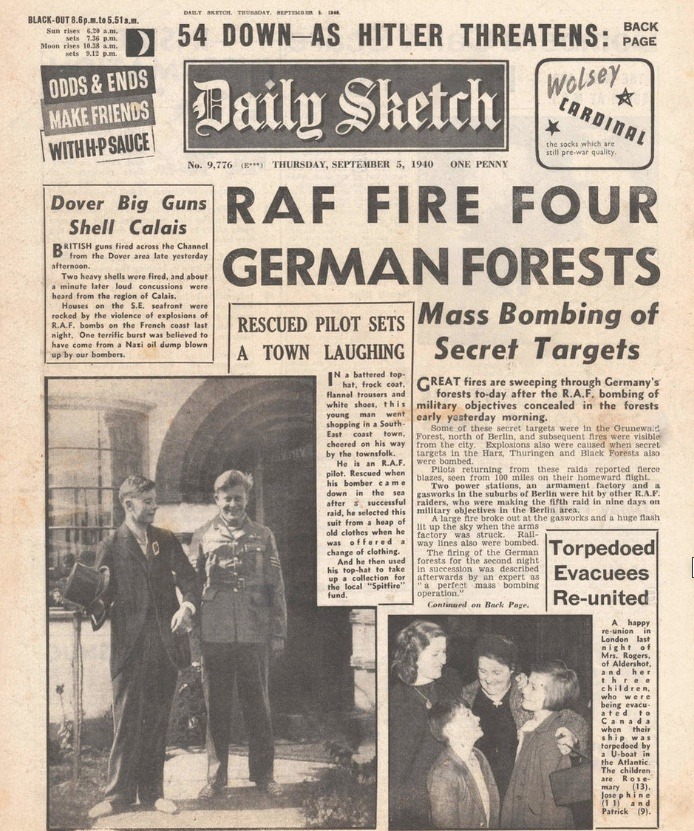
In “Operation Razzle,” 2-4 September, ten Wellingtons firebombed a few woodlands including the Black Forest—again without result. The timberland, Churchill was told, “is not easily ‘fired’ as its trees are mainly deciduous.”14
This is what the recent podcast described as “firebomb fleets” causing “rank terrorism” in “civilian neighborhoods.”
Razzle abandoned
While British and American newspapers reported “mass firing” and “new secret weapons dropped in millions,” the reality was very different. In fact, noted Berlin LuftTerror,
just a few fields had been burnt and that the fire didn’t spread much and as fast as desired following the first sorties. London quickly decided that Razzle did not possess war-winning potential, and was consigned to the ‘it was worth a try’ file.”15
With the September threat of a German invasion of Britain, the bombers turned to targets on the Channel coast. A year later, Hitler’s invasion of Russia again prompted Churchill to “make hell while the sun shines.” Prodded by H.G. Wells, he inquired of Air Marshal Portal: “What is the position about bombing of the Black Forest this year? It ought to be possible to produce very fine results.”
This was the first time Churchill, rather than one of his colleagues, raised the question. It went nowhere. Portal reminded him of 1940’s failure—and that the Black Forest was over 400 miles from the Channel. Closer targets were available.16
“Opium for the people”
So the fiery holocaust, the “fleets of bombers” over the Schwarzwald, the maniacal burning of helpless women and children (and, er, a major German ammunition dump) described by this podcast, never happened. The Air Ministry’s proclaimed objectives—“military stores, arsenals, ammunition factories, railway cars”—remained unmolested. Military targets are fair game in war, yet these weren’t touched.
As Andrew Roberts, Victor Davis Hanson and others have comprehensively documented, such “history” cannot be taken seriously. Permit me to quote a colleague who long ago dispelled similar falsehoods about Churchill and Pearl Harbor:
Allow me to vent for a moment. The reason why this kind of nonsense passes for history is that standards for evidence have virtually disappeared. Not all evidence is equal and there is an obligation to weigh evidence against some reasonable standard.
The standard is not exactly rocket science. Remnant evidence is better than tradition-creating evidence. Corroborated testimony is better than uncorroborated testimony. Forensic evidence is better than hearsay.
Our inability to be skeptical, to think critically, to ask questions, to compare and contrast, leads to the perpetuation of one urban legend after another, be it Churchill and Coventry, Churchill and the Lusitania, Churchill and Pearl Harbor, etc. Hard thinking, critical analysis, and skepticism are the only ways to challenge this rubbish. I sometimes despair. Vent off.17
Endnotes
1 Churchill at St. Barabas School, Woodford, 6 September 1952, in Richard M. Langworth, ed., Churchill by Himself (New York, Rosetta, 2015), 332-33.
2 Louis Spears, Assignment to Catastrophe, 1 vol. ed., London, Reprint Society 1956, 19.
3 Peter Fleming, Invasion 1940 (London: Rupert Hart Davis, 1956), 47.
4 Spears, 43. Harold Macmillan, The Blast of War 1939-45 (London: Macmillan, 1967), 8.
5 Macmillan, ibid. William Manchester, The Last Lion, Winston Spencer Churchill, vol. 2, Alone 1932-1940 (Boston: Little Brown, 1988), 578. Lynne Olson, Troublesome Young Men (New York: Farrar, Straus & Giroux, 2007), 224.
6 John Charmley, Churchill: The End of Glory (Sevenoaks: Hodder & Stoughton, 1993), 374.
7 Leopold Amery, My Political Life, vol. 3, The Unforgiving Years 1929-1940 (London: Hutchinson, 1955), 330.
8 John Barnes & David Amery Nicolson, The Leo Amery Diaries, vol. 2, Empire at Bay 1930-45 (London: Hutchinson, 1988), 559-60.
9 Langworth, 261.
10 Cecil King, With Malice Toward None: A War Diary (London: Sidgwick & Jackson, 1970), 2.
11 Charmley, 374.
12 Martin Gilbert, Winston S. Churchill, vol. 6, Finest Hour 1939-1941 (Hillsdale, Mich.: Hillsdale College Press, 2011), 498.
13 Air Ministry communiqué (Associated Press), The New York Times, 11 September 1940, 1.
14 Gilbert, 711. For a detailed description of Operation Razzle, see the blogsite Berlin LuftTerror, a balanced account of the air war against Germany (accessed 6 September 2024).
15 BerlinLuftTerror, ibid.
16 Gilbert, 1123-24.
17 Ron Helgemo, “A Review of Betrayal at Pearl Harbor by the History Channel, 7 December 1998, in Finest Hour 101, Winter 1998-99.
Audio and video
Andrew Roberts Debunks the Myths on School of War.
Rafal Heydel-Mankoo, “War Over Churchill” on Outspoken.
Related reading
Andrew Roberts, “No, Churchill was Not the Villain,” 2024 (Washington Free Beacon).
Manfred Weidhorn, “On Reputation: ‘If Churchill Had Not Been Ousted in 1942,” 2023.
Michael McMenamin, “Rumbles on the Right: The Raico Case Against Churchill,” 2022.
Richard M. Langworth, “Pat Buchanan and the Art of the Selective Quote,” 2023.
Herbert Anderson, “A New Gospel of Churchill Perfidy by Otto English,” 2022.
Andrew Roberts, “Wheatcroft on Churchill: Is This Taking Character Assassination Too Far?” 2021.





Slam Dunk! Massive historical truth/ Firebomb the neo-Fascists and their enablers.
This article, and the reproduced newspaper of 1940, are welcome reading. Thank you Mr. Langworth.
There seems to be more than a little bit of professional jealousy at play here, calling Mr. Cooper a “historian” in quotemarks. I heard his interview with Carlson and have listened to his podcast and would like to point out that he is not a Nazi apologist and does not praise Hitler or Nazis, and he isn’t a Holocaust denier either. What he does is read a lot of books, do some of his own research, and tell stories via his podcasts. He can tell stories that will keep millions engaged in history, surely something the folks at Hilldale [sic] would approve of. And, he notices things that are worth discussing, for example, in 1940, when Churchill became PM, 50,000,000 people were alive that would be dead in 1945, including 6,000,000 Jews. The Soviets would advance many miles west, and then Churchill would be coming to the US to get us to defend the UK, on our dime. So, did Churchill and British policy makers had no other choice? Would 100,000,000 be dead, but for Churchill? WW2 was a massive disaster, and it happened when Churchill was PM of a major player. And yet, he is blameless? Cooper notes that the “Chamberlin [sic] is an appeaser” and “Churchill a fighter” narrative has been invoked to start many wars, all of which the U.S. failed to win. That story is worth looking more closely at, and will be.
–
Mr. Langworth responds: (1) The quotemarks around “historian” are because I found no evidence that the gentleman has either a degree in history or has published a single history book. (2) I never called him a “Nazi apologist,” “Holocaust denier” or “Hitler praiser.” You must be viewing one of the three dozen other pushback articles, audios and videos appearing in the wake of his unfounded charges. There are certainly lots to choose from. (3) Aside from establishing that his arguments are hardly new, my article covered only one of his assertions: that Churchill firebombed the Black Forest. At this College we are fond of facts, the facts are now published, and facts are stubborn things. (4) The notion that fifty million people would have lived on if we didn’t fight WW2 is like saying 630,000 Americans would have been alive if Lincoln let the South secede and keep its slaves. Some things are worth fighting for. (Nor am I sure 50 million would have survived, since Hitler’s forward plans went far beyond the seventeen million Untermenschen he managed to slaughter before we stopped him.) But keep your powder dry, because if you’re upset at my essay, you haven’t seen anything yet. Watch this space!
Thank you so much! I listened to the Carlson interview and it just wasn’t adding up. Thank you for actually providing citations and first hand accounts. Too often to make a name for themselves people will just say incendiary things. “Keep calm and carry on.”—Churchill.