
Subscribe now and receive weekly newsletters with educational materials, new courses, interesting posts, popular books, and much more!
Articles

Questions and Answers on Churchill’s WW2 Memoirs
No Comments

FDR and WSC on the quarterdeck of HMS Prince of Wales for Sunday services during the Argentia Conference, 10 August 1941. In the row behind (l-r): Air Chief Marshal Sir Wilfred Freeman; Admiral E.J. King; USN; General Marshall; General Sir John Dill; Admiral Stark, USN; Admiral Sir Dudley Pound. Next row back (l-r): General Arnold, USAAF; Sumner Wells; Harry Hopkins; Averell Harriman; Major General E.M. Watson, US Army. On the left behind General Arnold are the President's sons, Captain Elliott Roosevelt (left) and Ensign Franklin Roosevelt. (Imperial War Museum, public domain)
The Churchill Project is always pleased to answer questions from interested readers. In this case we publish a trio related to his six-volumes, The Second World War. We use herein the sobriquet WW2 as shorthand and for technical reasons, and trust readers will forgive this jargon. (We always tend to prefer “Second World War.”) Questions of any kind are welcome at [email protected].
Q: WW2: Was it history or a memoir?
It is well known that Churchill regarded his volumes on WW2 as a personal memoir. Is there an actual quote where he says that they weren’t intended to be an objective history, but rather his own story? I seem to recall such a statement, but is it between quotation marks? —A.H., Conn.
A: A memoir
Churchill did make such a statement, in the preface to his first WW2 volume, The Gathering Storm: “I do not describe it as a history, for that belongs to another generation. But I claim with confidence that it is a contribution to history which will be of service to the future.”1
In fact, this approach had governed his earlier memoir of the Great War, The World Crisis. In volume 2 of that work he wrote:
I must therefore at the outset disclaim the position of the historian. It is not for me with my record and special point of view to pronounce a final conclusion. That must be left to others and to other times. But I intend to set forth what I believe to be fair and true; and I present it as a contribution to history of which note should be taken together with other accounts.2
In the foreword to the abridged and revised one-volume edition of The World Crisis, Churchill described his book as “a contribution to history strung upon a fairly strong thread of personal reminiscence. It does not pretend to be a comprehensive record; but it aims at helping to disentangle from an immense amount of material the crucial issues and cardinal decisions.”3
***
Sir Martin Gilbert noted that the WW2 memoirs had to wend their way “between much ‘rubbish,’ conflicting recollections, Anglo-American disagreements and personal accusations.. (This was far more understanding than some later historians, who cast the volumes as promotion and special pleading.) Gilbert quoted Churchill’s literary assistant Bill Deakin:
Winston’s attitude to the war memoirs was “this is not history, this is my case.” He made it absolutely clear that it was his case he was making. It was an anthology—with his own papers—not a history. It was extremely difficult not to put everyone’s case. The difficulty was not how to distort his case (which he did not want to do) but how not to distort other people’s views—while remaining autobiographical and not writing a history.”4

In both sets of memoirs, we must be grateful that Britain was led by a professional writer. Churchill set out the story from his and Britain’s standpoint. “In his speeches during the war and his memoirs afterwards, he often ignored unpleasant facts, or put his own spin on them. Yet few writers were so magnanimous, refusing for example to criticize his predecessors for the sake of unity and the national effort.”5
Q: How important is it to remember the past?
Did Churchill say, “a nation that forgets its past has no future”? If not, were those his sentiments? —M.H., N.J.
A: Very important
Although he is quoted (without attribution) as saying those words in at least one quotations book, Churchill never said this. It is not certain that he would take so censorious a view. Yet there is no doubt that he believed in the past as a guide to the present.
Though he was the most magnanimous of statesmen, he saw the purpose of citing past mistakes: “I will tell the House the use of recriminating about the past,” he said in a 1936 armaments debate: “It is to enforce effective action at the present.”
In 1936, on the eve of Hitler marching into the Rhineland, he added: “We are not in a position to say tonight, ‘The past is the past.’ We cannot say, ‘The past is the past,’ without surrendering the future.” But four years later, now prime minister, he took a milder approach: “If we open a quarrel between the past and the present, we shall find that we have lost the future.”6
Bottom line: Churchill always believed that history was crucial in taking current decisions. He did not believe in censuring leaders for past mistakes; only in recognizing errors, and trying to avoid repeating them.
Q: Did Churchill spin FDR at Argentia?
Did Churchill spin Roosevelt on the back of a battleship during Sunday services to induce USA to join Britain in the WW2 fight? —J.P., Ark.
A: No, that took time and the enemy
Contrary to the Netflix series Churchill at War, WSC did not try to talk the President into entering the war alongside Britain during the Atlantic Charter meeting at Argentia, Newfoundland in August 1941. He was fairly sure that Britain alone could not win the war. He was also aware of the strong anti-war sentiment in America, and could hope only for a softening of that attitude. Argentia was simply a step in that process, and Roosevelt was very much in his thoughts. He said in 1948: ”No lover ever studied every whim of his mistress as I did those of President Roosevelt.”7
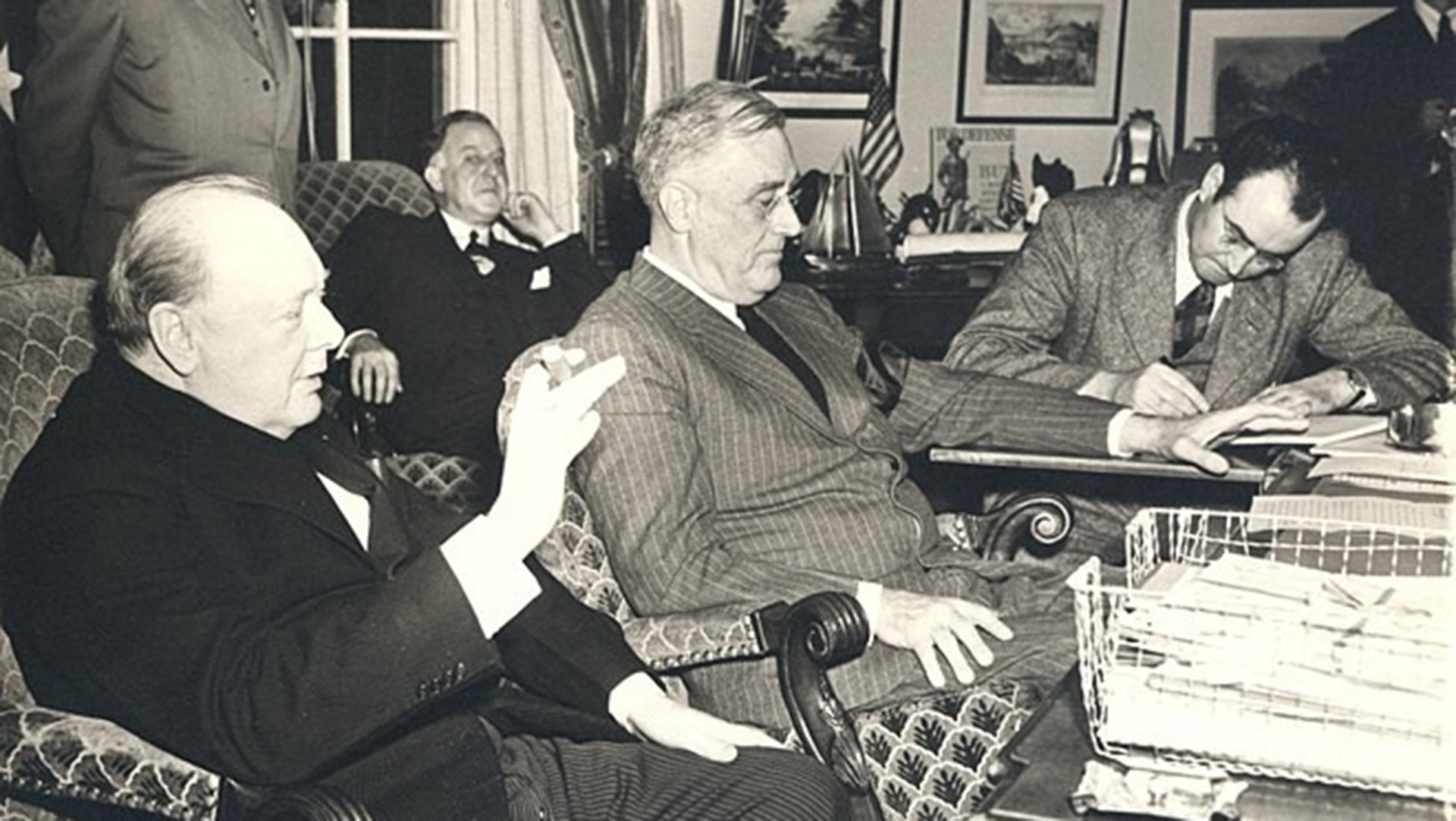
Remember that in August 1941, Russia was falling back under the German invasion and seemed to face defeat. In fact, Churchill was despondent by November 1941, thinking the United States would never come in.
Of course FDR had loaned Britain fifty aged destroyers (September 1940), and pushed through Lend-Lease (March 1941). and But that was a far cry from declaring war—which, as Churchill knew, only Congress could do.
***
Everything changed in December with the attack on Pearl Harbor and Churchill’s rush visit to Washington. He was anxious to ensure that America adopted the policy of ”Germany first.” In his WW2 memoirs, he wrote eloquently of his feelings:
I thought of a remark which Edward Grey had made to me more than thirty years before—that the United States is like “a gigantic boiler. Once the fire is lighted under it there is no limit to the power it can generate.” Being saturated and satiated with emotion and sensation, I went to bed and slept the sleep of the saved and thankful”….
No American will think it wrong of me if I proclaim that to have the United States at our side was to me the greatest joy.… So we had won after all! Yes, after Dunkirk; after the fall of France; after the horrible episode of Oran; after the threat of invasion…we had won the war. England would live; Britain would live; the Commonwealth of Nations and the Empire would live.8
Related reading
Bradley P. Tolppanen, “Churchill Day Book for 1941: The Grand Alliance,” 2024.
Christopher C. Harmon: “When Will It End?: Churchill’s Exquisite Sense of Timing,” 2024.
Warren F. Kimball, “Kluger and Evans on the Atlantic Charter: Less Than Meets the Eye,” 2022.
Richard M. Langworth, “‘Trumpets from the Steep’: Churchill’s Second World War Memoirs,” 2023.
_____ _____, ”Researching the Atlantic Charter Conference: Some Useful Tips,” 2019.
Endnotes
1 Winston S. Churchill (hereinafter WSC), The Gathering Storm (London: Cassell, 1948), vii.
2 WSC, The World Crisis, vol. 2, 1915 (London: Thornton Butterworth, 1923), 9.
3 WSC, The World Crisis, abridged and revised one-volume edition (London: Thornton Butterworth, 1931), 15.
4 Martin Gilbert, Winston S. Churchill, vol. 8, Never Despair 1945-1965 (Hillsdale, Mich.: Hillsdale College Press, 2013), 315.
5 Richard M. Langworth, Churchill in His Own Words (London: Ebury Press, 2012), 13-14.
6 “Recrimination,” ibid., 24. The three quotes are from 29 May 1936, 4 March 1938, and 18 June 1940. He repeated the last remark on 28 November 1945 at a meeting of the Conservative Party Central Council.
7 WSC to Jock Colville, 3 May 1948, in Gilbert, Never Despair, 416.
8 WSC, The Grand Alliance (London: Cassell, 1950), 514, 539.
The author
Richard M. Langworth CBE has served Hillsdale College as Senior Fellow for the Churchill Project since 2014. He is the author or editor of twelve books and a thousand articles about Sir Winston, his latest book being Churchill: Master of Language (Hillsdale College Press, 2025).