
Subscribe now and receive weekly newsletters with educational materials, new courses, interesting posts, popular books, and much more!
Articles

“Much To Be Thankful For”: Reparations and Magnanimity, 1918
No Comments

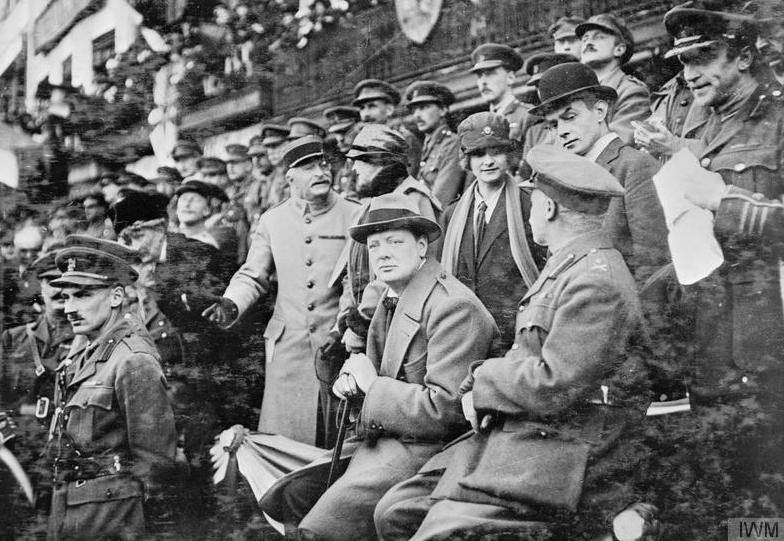
Minister of Munitions Winston Churchill with Field Marshal Douglas Haig (center) and unidentified French general in Paris, circa 1918-19. (National Library of Scotland, public domain)
Q: “More still to hope for”
I discovered this quote, dated 9 December 1918, in Churchill In His Own Words, page 238: “I cannot but think we have much to be thankful for, and more still to hope for in the future.” Was Churchill trying to rationalize the relatively modest reparations the Allies were demanding of Germany?
We have been caught out in the past with Churchill quotes that were misattributed, so I am pleased if you can verify this and discuss the context. —R.C. Canberra, A.C.T. Australia
A: German reparations
The quotation indeed relates to the fraught question of how much reparations to demand of Germany after the First World War. It is from Churchill’s letter to a constituent shortly after the 1918 Armistice. After four years of slaughter and destruction, most Britons favored massive reimbursements.
Churchill, who urged moderate reparations, defended his view in The Aftermath, fourth volume of The World Crisis, his memoir of the Great War. So critical did he regard the issue that he reprinted two replies to constituents on the subject.
More than a defense, his comments offer an example of prudent statesmanship. While Churchill consistently had doubts about “Unconditional Surrender,” his view toward changing borders varied. Readers will decide whether this inconsistency was warranted. As WSC once remarked, “I occupy the impartial position of historian.”1
“Unconditional surrender”
Ten days after the Armistice a Dundee constituent, James K. Foggie, wrote Churchill demanding maximum reparations:
Your last speech in which you declared you did not want Unconditional Surrender from the Germans has certainly given you a setback in Dundee. Now as one of your electors, and a worker who has always given his whole time to further your interests during an election, I am writing to give you an idea of the feelings in your Constituency.
Now that we have beaten the Germans, we must deal with them as they did to the French in 1870-71…. I think the great card to play, and one which will give you a huge victory, is that you declare that “Germany must pay this country and the other allied Nations, all expenses caused by the War.”
Germany started the War, and has been defeated, therefore it stands to reason she must pay. Had Germany beaten our Empire she certainly without any doubt, would have made us pay all expenses. Dundee will stand nothing else. Dundee has given over 30,000 soldiers. Almost twenty percent, over 3000 [sic], have been killed.2
“The same evil consequences”
Churchill replied the next day, politely but firmly challenging the writer:
[D]o you think that you are quite right in saying that we ought to impose upon Germany the same sort of terms as they imposed upon France in 1871? Surely the forcible annexation by Germany of Alsace-Lorraine against the will of the people who lived there and who wanted to stay with France was one of the great causes at work in Europe all these years to bring about the present catastrophe…. [S]hould we not run the risk of committing the same crime as the Germans committed in 1871 and bringing about the same train of evil consequences?
Reparations, Churchill continued, could take only three forms: gold and securities, forced labor, or payment in goods. The first “could only be a drop in the bucket.” Germans “coming to work for us” would “take the bread out of the mouths of our own people.” Payments in goods “would undercut our own trade here.” This would create “that very dumping against which our own manufacturers are so much up in arms.”
Churchill added that the Allies had demanded reparations of £2 billion for war damage, but not expenses of the war (estimated at £40 billion). The latter figure was impossible. He urged Mr. Foggie to trust in the Allies to “stand firm upon those great principles we have fought.”3
Hope for the future
The quotation you cite occurs in a second letter Churchill to another constituent wrote two weeks later. As in November, he urged caution:
If the peace which we are going to make in Europe should lead, as I trust it will, to the liberation of captive nationalities, to a reunion of those branches of the same family which have long been arbitrarily divided, and to the drawing of frontiers in broad correspondence with the ethnic masses, it will remove for ever most of the causes of possible wars. And with the removal of the Cause, the Symptom, i.e., armaments, will gradually and naturally subside.
I cannot but think we have much to be thankful for, and more still to hope for in the future.4
“Squeeze till the pips squeaked”
Churchill’s support for moderate reparations exposed him “to a charge of being pro-German or at best a weakling. Not only the ordinary electors, but experts of all kinds, financial and economic, as well as business men and politicians, showed themselves unconsciously or willfully blind to the stubborn facts.”5
Prime Minister David Lloyd George understood this. A Treasury committee had declared reparations of $2 billion spread over thirty years to be “reasonable and practicable.” In the December 1918 election, Churchill continues,
I held firmly to the Treasury estimate. I dressed it up as well as possible. “We will make them pay an indemnity.” (Cheers.) “We will make them pay a large indemnity.” (Cheers.) “They exacted from France a large indemnity in 1870. We will make them pay ten times as much.” (Prolonged cheers.) “200 millions times 10 = 2000 millions.” Everybody was delighted….
Then came a hectoring telegram from an important Chamber of Commerce, “Haven’t you left out a nought in your indemnity figures?” The local papers gibbered with strident claims. Twelve thousand millions, fifteen thousand millions were everywhere on the lips of men and women who the day before had been quite happy with two thousand millions, and were not anyhow going to get either for themselves….
I stuck to my two thousand millions, and this figure has not yet been impugned. But all over the country the most insensate figures were used. One Minister, reproached with lack of vim, went so far as to say, “We would squeeze the German lemon till the pips squeaked,” and many private candidates with greater freedom and even less responsibility let themselves go wherever the wind might carry them.6
Changing perspectives
“I cannot pretend not to have been influenced by the electoral currents so far as verbiage was concerned,” Churchill added. That was typical. He always tried to tell voters what he thought they should hear, not necessarily what they wanted to hear.
In the event, however, reparations did squeeze Germany until the pips squeaked. In October 2010, the German government at last paid off a Great War debt one historian estimates at $500 billion.7 (Churchill’s £2 billion of 1918 is only about a fourth that much in today’s money. Of course there was also interest.)
In both World Wars Churchill had doubts about “Unconditional Surrender.” He loyally backed it when Roosevelt declared it in the Second World War; he spoke against it in the First. Perceptive readers will notice a change of view about borders and “captive nationalities.” In 1918 he opposed shifting populations against their will, condemning Germany’s 1870 annexation of Alsace-Lorraine. In 1945 he was agreeable, even anxious, to redefine the Polish state at the expense of Poles in the east and Germans in the west. But by then there were graver worries, and no one was speaking of a “war to end wars.”
Endnotes
1 Winston S. Churchill (hereinafter WSC), House of Commons, 26 April 1927, in Richard M. Langworth, Churchill by Himself (New York: Rosetta, 2015), 552. Churchill had been asked his opinion of Prime Minister Gladstone.
2 James K. Foggie to WSC, 21 November 1918, in Martin Gilbert., ed., The Churchill Documents vol. 8, War and Aftermath, December 1916-June 1919 (Hillsdale, Mich.: Hillsdale College Press, 2009), 422-23.
3 WSC to James K. Foggie, 22 November 1918, ibid., 423-24.
4 WSC to Richard Lee, 9 December 1918, ibid., 432-33.
5 WSC, The Aftermath (London: Thornton Butterworth, 1929), 46.
6 Ibid., 46-47.
7 Erin Blakemore, “Germany’s World War I Debt Was So Large It Took 91 Years to Pay Off,” History.com, 5 September 2024, accessed 31 October 2024.